Today I've been doing my homework for my mentoring course and reading part of the set text, The Potter's Rib, Brian A Williams, pub. Routledge, 2005. The set chapter, one of the longest in the book (of course!) at around sixty pages, talks about the pastor as mentor - a key theme of the course. We were asked to identify and consider the images offered by the writer and to come prepared to discuss these on Monday.
I guess there are two dominant images, the titular 'potter's rib' (a device used by potters to assist them in forming the clay) and the midwife. It seemed to me there were a whole host of other metaphors and models, some explicit, some implicit, including, roughly in the order they arise...
- friend
- host
- companion
- accompanier
- eyes
- liberator
- encourager
- ears
- creator of space
- confessor
- mouth/voice
- conversation partner
- poet
- helper
- midwife
- paraclete/advocate
- model/pattern/example/'type'
- artist
- dance partner
- bearer of gladness
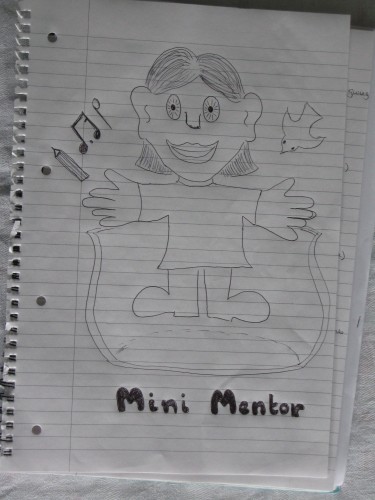
Obviously each of these embraces aspects of the dominant metaphors, but they seem to add other ideas too. As I was mulling them over, and finding myself once more recollecting the 1 Corinthinns 12 body image and the need for diversity in unity, I doodled a 'mini-mentor' based on some of these ideas. (Just before anyone assumes she's standing in a missionary-sized cooking pot, she isn't, it's a clay pot being formed... obviously)
She is a she because most midwives are women. She has enormous eyes, ears, mouth, hands, feet to reflect the attributes, not because she's a wolf in grandma's clothing. She's smiling because she's glad. Hopefully the dove, pencil and music notes are self evident.
But what of the dominant metaphors/images employed in the book?
The potter's rib seems to be defined very much in terms of God as first person of the trinity, or as first 'function' as creator. The mentor is a tool employed by the potter to shape the pot. Whilst it is a good image in some ways, the inherent passivity of the tool is a weakness - our own personalities inevitably play a part helping or hindering what God is doing. It is also very much a one-way image - God uses us to shape the mentee - whereas the reality is more reciprocal (at least if it works well) more an 'iron sharpens iron' approach or that of two rough stones smoothing each other through friction as they rub together. I guess it becomes a very hierarchical image if pushed too far - God controls me as I press the mentee into the desired shape.
By contrast the midwife seems to be more of a third person of the trinity (Holy Spirit) image, centred on 'birthing' and is a feminine image. Again, it has its good features, not just recognising the feminine in the divine. It is an image of accompaniment and encouragement as a person does what only he/she can do in 'giving birth' to themself as pastor. One of its limitations is perhaps that the midwife may not be a mother so may not have experienced first hand that which she tells another to do (it is apparently amazing how many midwives are shocked by their own experiences of childbirth and vow never to be the same afterwards...). Another is the necessarily brief role of the midwife; the mentor is perhaps more health visitor/district nurse as she/he may support the mentee for extended periods (up to four years in an English Baptist context; not sure in Scotland)
What seems to be missing is any explicit image allied to the second person of the trinity (Christ) and I wonder why this might be? Is it a reformed theology reluctance to see a priest as an icon of Christ? Is it a fear of implying a redemptive role to the mentor if any sort incarnational understanding is expressed? Or is it a reluctance to confuse mentor with 'teacher' or 'rabbi'? To be fair to Williams, he does speak of model/pattern in the role of the mentor, but not as a dominant image. Whilst I would be very reluctant to see a mentor as a 'teacher' (i.e. somehow superior) there is something about the 'companion on the way' about the 'living example' that hints more at Jesus of Nazareth than either God the Father or the Holy Spirit.
Of course, none of these images is exclusive or complete, it is only as they are allowed to intertwine and inform each other, as the 'like' and 'not like' of metaphor does its work and the merry dance of perichoresis continues that glimpses of what might be emerge.
As to what kind of mentor I am... well hospitality, encouragement, appropriate vulnerability, honesty and accompaniment seem like a good beginning. My group of NAMs at last year's NAM conference reckoned I was OK so I'm happy!