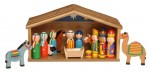
On Christmas day we had our little quiz about "truth and tradition" in the Christmas story - the answer to most of the questions being 'actually we don't know.' We don't know what colour Mary wore, how old Joseph was, what the angels looked like, how many Magi there were or how anybody travelled to Bethlehem. Yet the so-called traditional nativity scene is how most people envisage Christmas; most Christians live with a neat synthesis of Luke/Matthew that skips over inconsistencies to bring us to a tableau in which shepherds stand stage right, along with a donkey and a lamb, and three kings, one with black skin and possibly one with oriental features, stand stage left along with a camel and three elaborate caskets. I ended my 'quiz' with the idea from the book whose title I've forgotten that somehow God can speak 'new' or 'different' truth through this - that Christ is where rich and poor, educated and uneducated, black, white and 'everything in between' meet on equal terms. That the whole of creation - humans, animal and maybe even vegtable and mineral - bow, or are laid, at the feet of their creator. The familiar nativity scene isn't 'true' but it contains 'truth'
If this is so for scripture, could something be similar for history? And in particular Baptist history? If history is 'created as much as found' or is a form of 'creative non-fiction', how might it parallel or differ from the nativity play?
The Baptist histories I have read so far are definitely synthetic - the origins of one strand, the heroes of another and the useful bodies of a third are carefully drawn together into a nice whole, with struggles, tensions and inconsistencies neatly ignored to present an inoffensive whole.
So, if there are to be parallels with nativity stories, what, if any, 'new' truth arises from this synthesis? What is distorted? What is lost along the way? In what way does the 'traditional' story work?
I think that some of what it (Baptist history) loses, and is diminished by, is the loss of struggle and tension, it becomes as clean and saccharine as the Christmas card glittery nativity. The Bible is not a nice, happy story: both Luke and Matthew (especially Matthew) drop hints of the pain that accompanies Jesus - promises of a sword piercing Mary's heart, babies slaughtered by a megalomanic ruler; not a nice story for the kiddies, I fear.
The synthetic nativity story has its place in our Christmas celebrations. It has its place in learning the stories of Jesus. And while it is not 'gospel truth,' it can, with some theological creativity, point us to gospel truths. For all that, we don't expect Christian disciples to stick with Mary in a blue dress and a baby who never cries; we expect them to cultivate a habit of discovering more and more about Jesus the man, the prophet, the Son of God, the saviour (see John 9, the man born blind, for support of this model of disicpleship). Yet, when it comes to history, the history of our own faith tradition, we seem content with the infant school version. Granted, it is not the most earth shatteringly important thing for us to devote time to, but I can't help feeling we miss out on useful insights into what it might mean to follow Jesus in an authentically 'Baptist' kind of a way because we don't actually take time to discover what our own story really is.