This week as I have prepared for our Pentecost service I have had a lot of fun, but struggled with the middle reflection of the three, partly because of the incredible diversity of people in the congregation and my, sometimes stifling, fear to offend and desire to be liked! I wrote something yesterday but woke up today sure it wasn't right, not because it was wrong, but because it detracted from what I wanted/needed/was led (you decide) to say. But what to do with it? After much rumination I've decided to post it here, one step removed from reality, one step away from those who might poo-poo the charismatic/supernatural angle, one step away from those who feel that the trajectory BUGB is following is too slow/fast/inadequate/incorrect. This is my blog, these are my views, no-one else carries any responsibility for them and, whilst I hope this does not offend, it is what it is.
So, with a few annotations and emendations, here's what I wrote:
In 2013 the BUGB/BMS Assembly met in Blackpool and devoted a significant period of time to small group discussions on the topic of human sexuality and, specifically, in the light of changing legislation, how churches might wish to engage with the topic and to respond in practice. It was a good conversation, characterised by generosity and grace, and as the chair person summed up what had been sensed by the ‘listeners’ as the mood of the gathering, a pigeon (a rock dove) overflew the auditorium. Some, myself, among them, wondered, was this a sign? Was this a manifestation of God’s Spirit? Or was it coincidence, a pigeon nesting in the roof had just flown by at that moment. [I wrote about this at the time here]
A year went by and I forgot all about this moment. At the 2014 Assembly someone read out a statement from BUGB on “where we are up to” on the topic which, significantly included this:
As a union of churches in covenant together we will respect the differences on this issue which both enrich us and potentially could divide as we seek to live in fellowship under the direction of our Declaration of Principle ‘That our Lord and Saviour Jesus Christ, God manifest in the flesh, is the sole and absolute authority in all matters pertaining to faith and practice, as revealed in the Holy Scriptures, and that each church has liberty, under the guidance of the Holy Spirit, to interpret and administer His Laws.’
Upholding the liberty of a local church to determine its own mind on this matter, in accordance with our Declaration of Principle, we also recognise the freedom of a minister to respond to the wishes of their church, where their conscience permits, without breach of disciplinary guidelines.
[I wrote about, and linked to the BUGB website, on this here]
For BUGB accredited ministers this is huge – pastorally and professionally, removing the fear of loss of employment, home and pension for saying or doing something that breached the rules for accreditation. For some it is a step too far for others it is nowhere near far enough. But it is part of a new understanding, a new way of being…
[this next bit wasn't in the sermonette but is part of the story, so I've written it initalics]
Last Sunday I was handed a copy of the new edition of the church magazine, its cover resplendent with a striking piece of artwork depicting the Holy Spirit as a dove:
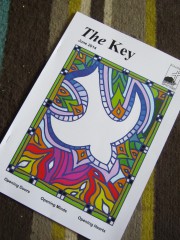
(original artwork Celtic Flame (c) John Stuart)
As I admired the cover suddenly my mind was flooded with remembrance of the pigeon overflying the Assembly and the (to me anyway) significant shift that had occurred in the year following that... I felt, well, how did I feel? Kind of shuddery as if something 'highly spooky' was afoot; kind of 'wow' as if I was privy to something special, kind of dumb-struck and nearly tearful and awe-filled and, well I dunno, feelings are not my strong suit to describe but there was a real 'a-ha' or 'hmmm' moment, perhaps a pentecostal/charismatic/spiritual experience...
and yes, if only retrospectively, I think I am convinced that the pigeon, the dove, in Blackpool was God’s Spirit manifest in physical form. And if that makes me a bit bonkers so be it. And if that makes me an irredeemable heretic so be that too.
So there you have it. I can't prove it was God's spirit. I can't demonstrate or reproduce any of it. But as far as I'm concerned it was real ... All of which means that, to quote the old adage, I must be mad or bad or it was, afterall, God.